



No products in the cart.

When a modern diesel engine in an excavator, bulldozer, loader, crane, or other heavy equipment does not start. Therefore, replacing parts one by one is rarely the right approach. In assessing why does an electronic diesel engine not start, diagnostics matter before replacement.
Electronic engines depend on the ECM, sensor signals, fuel-pressure control, injector command, safety inputs, and communication between control modules. A fault in any of these areas can result in a no-start condition.
The first step is to determine:
However, does the engine crank, or does it not crank?
The diagnostic approach is different for each condition.
1. Engine Does Not Crank
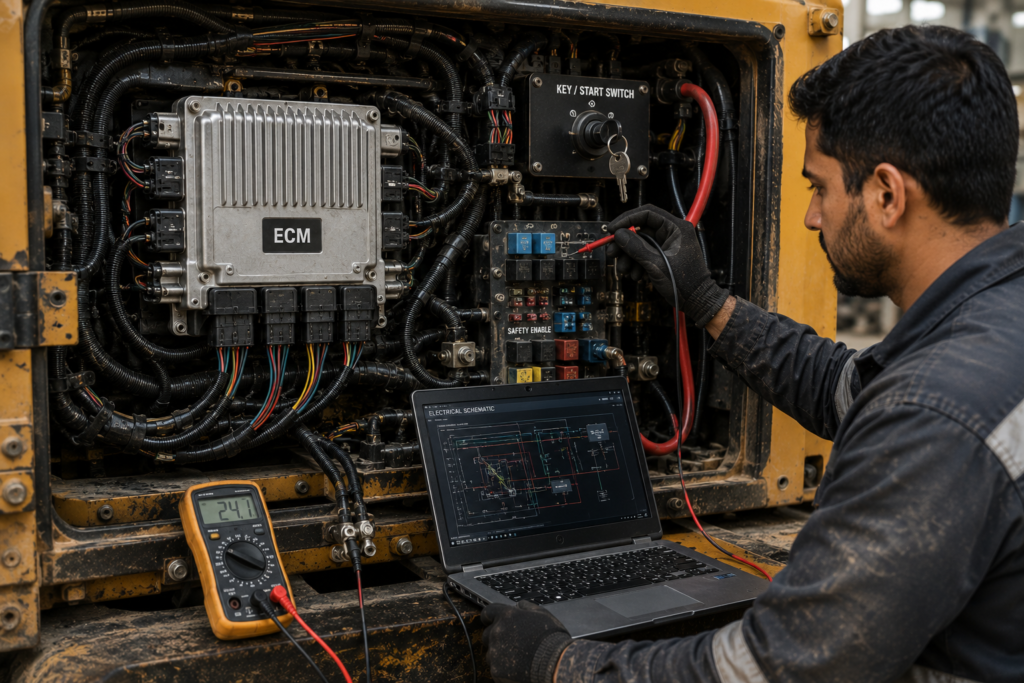
If the engine does not crank, start with the machine’s electrical and electronic control system.
Check the Main Power Supply
First verify whether the machine uses a 12V or 24V electrical system, according to its specifications.
Check:
- Battery voltage
- Battery positive and ground
- Voltage stability during the start command
- Main power connections
Then check whether the required battery power is reaching the electronic control circuits.
Check Key Switch and Start Enable
Then Verify the battery-positive supply at the key switch and confirm that the correct switched output is produced when the key is turned to the start position.
The next step is to check the machine’s safety enable/disable conditions. Depending on the machine, these may include neutral position, operator-related inputs, or other safety interlocks.
Check ECM Power and Ground
Before suspecting an ECM, verify:
- ECM battery supply
- Ignition supply
- ECM grounds
- Fuses and relays
- Voltage drop on power and ground circuits
If these are correct, continue tracing the start command and ECM control output.
Possible solution: Repair the confirmed power, ground, start-enable, wiring, communication, or control-circuit fault before replacing any major component.
2. Engine Cranks but Does Not Start
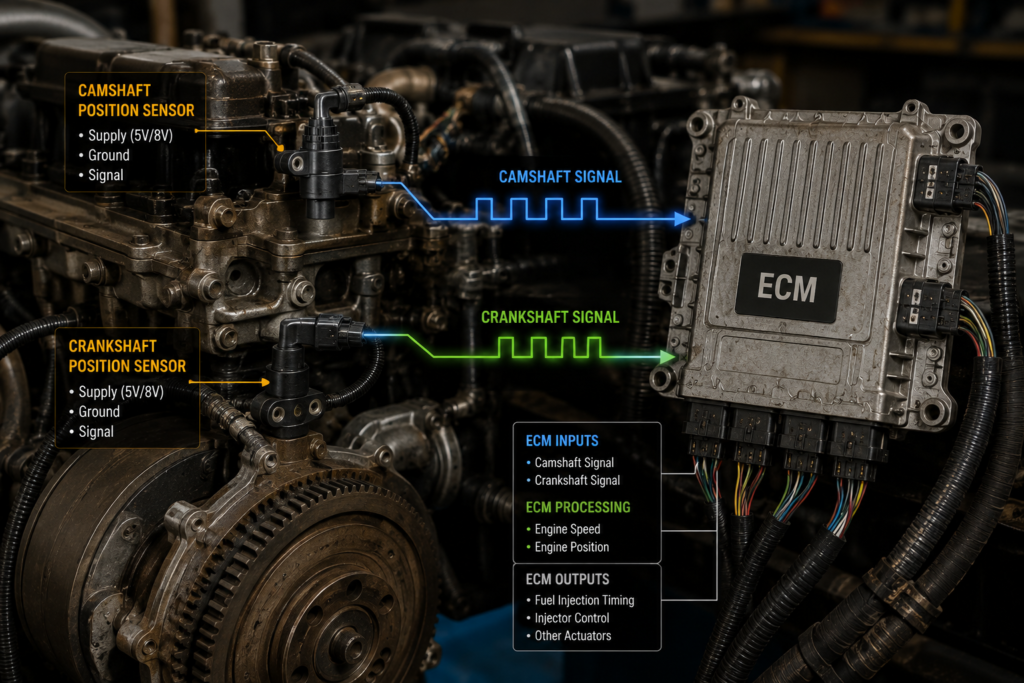
If the engine cranks normally but does not start, the focus shifts to the electronic systems responsible for engine position, fuel pressure, and injection control.
A practical diagnostic sequence is:
ECM Power → Sensor Supply → Crank/Cam Signals → Synchronization → Rail Pressure → Injector Command → DTC/CAN
3. Check Sensor Power and Crank/Cam Signals
Before replacing a sensor, verify that it has the correct supply and ground/reference specified for that engine.
For the crankshaft and camshaft position sensors, check:
- Sensor supply
- Ground/reference
- Signal
- Wiring and connectors
- Signal reaching the ECM
- Engine RPM during cranking
- Cam/crank synchronization
Checking the signal at the ECM is important. A sensor may produce a good signal at the sensor, but damaged wiring or a poor connector can prevent that signal from reaching the ECM.
Possible solution: Repair the wiring or connector if a circuit fault is found. Replace the sensor only after testing confirms that the sensor itself has failed.
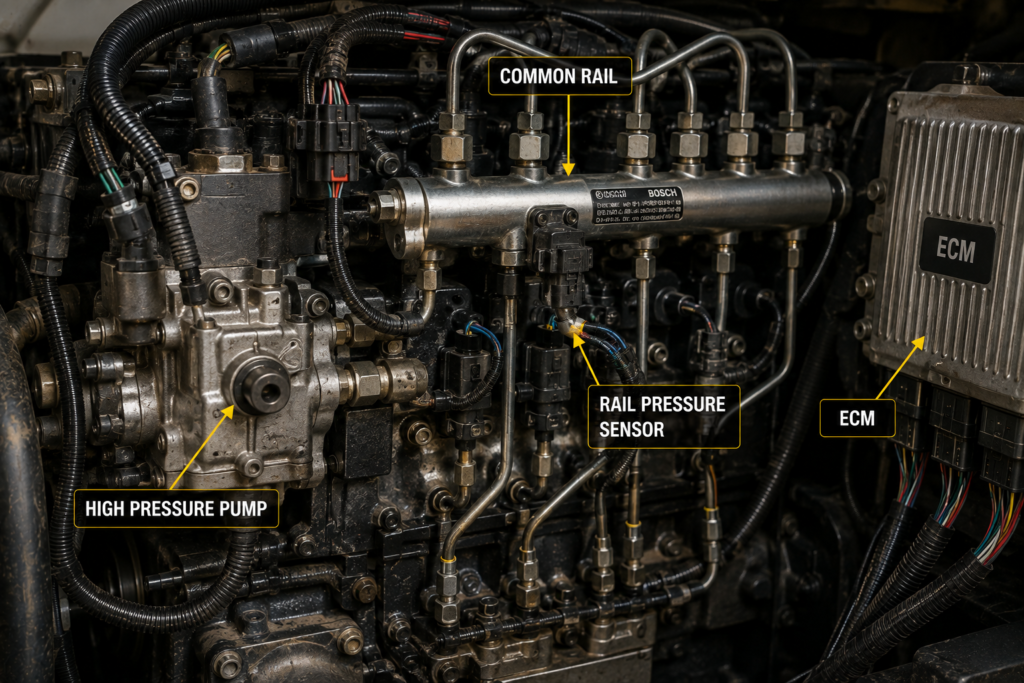
4. Check Common Rail Pressure
For a common-rail diesel engine, adequate fuel pressure during cranking is essential.
First check the rail pressure sensor circuit:
- Supply
- Ground/reference
- Signal
- Wiring
- Connector
Then compare desired/target rail pressure with actual rail pressure during cranking.
If actual pressure is too low, investigate the fuel-pressure generation and control system instead of immediately replacing the pressure sensor.
Possible solution: Determine whether the problem is related to pressure generation, pressure control, or pressure sensing, then repair the confirmed fault.
5. Check Injector Command
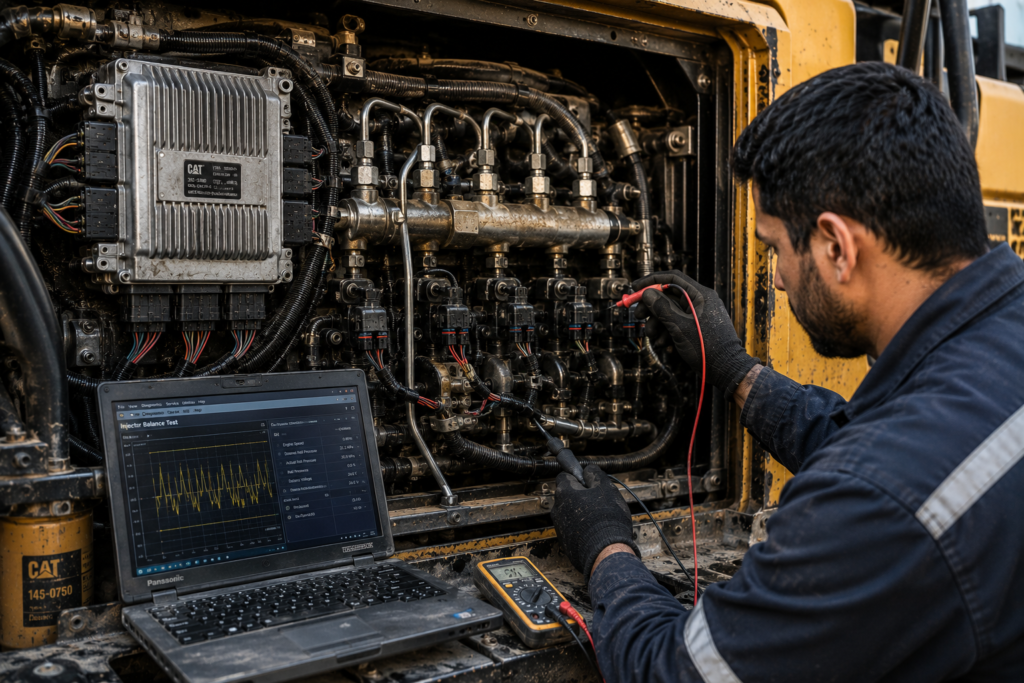
Once engine speed, synchronization, and fuel pressure have been verified, check whether the ECM is providing the required injector command/drive signal.
Depending on the engine system, check:
- Injector command/drive signal
- Injector wiring
- Connector condition
- Injector circuit
- ECM output
- Related DTCs
If the expected injector command is missing, do not immediately replace the injector. A missing RPM signal, synchronization problem, insufficient rail pressure, enable condition, wiring fault, or another ECM input can prevent injector operation.
Possible solution: Trace the injector control circuit, identify the reason for the missing command, repair the confirmed fault, and retest.
6. Check DTCs and CAN Communication
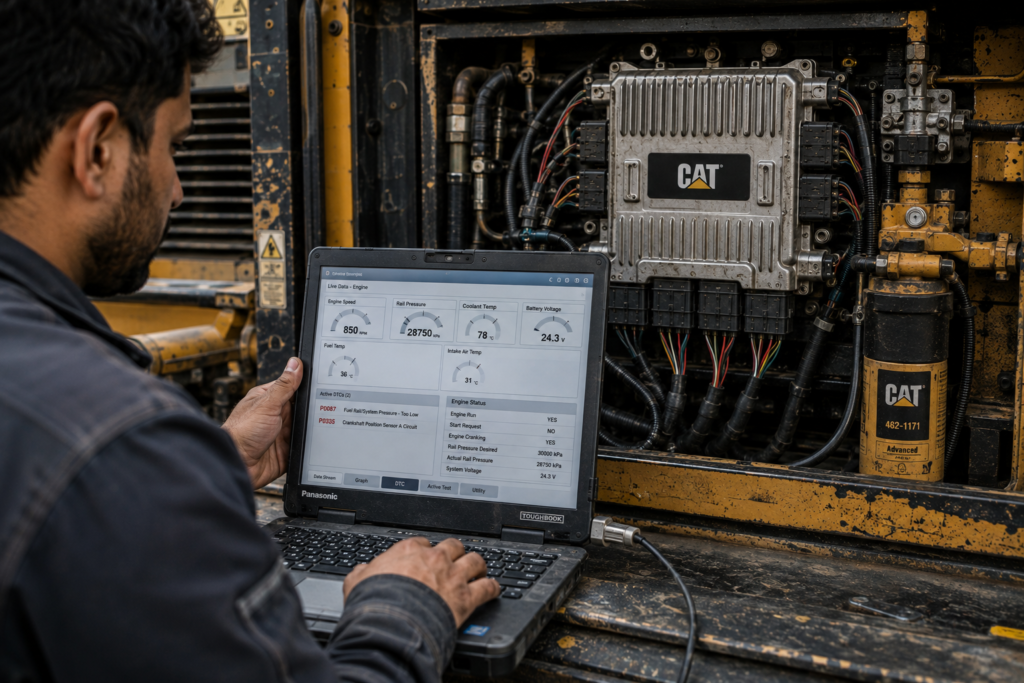
Diagnostic Trouble Codes and live data can significantly reduce troubleshooting time.
Check:
- Active and logged DTCs
- Engine RPM
- Sensor parameters
- Rail pressure
- Synchronization status
- ECM communication
- CAN communication
A fault code should be treated as a diagnostic clue, not automatic proof that a component has failed.
A fault code tells you where to investigate. Testing confirms what actually failed.
7. If Electronic Checks Are Normal
If ECM power and ground are correct, sensor signals and synchronization are valid, rail pressure is within specification, injector control is available, and communication is functioning normally, then mechanical causes can be investigated.
Depending on the engine, this may include:
- Compression
- Valve timing
- Injection timing
- Timing components
- Internal engine condition
Mechanical checks should always follow the manufacturer’s specifications.
The Right Approach to Electronic Diagnostics
A no-start condition should not become a process of replacing one component after another.
Whether the suspected component is an ECM, sensor, injector, controller, or wiring harness, the relevant circuit should be tested before the component is replaced.
A simple diagnostic principle is:
Test → Confirm → Repair → Retest
This approach helps reduce unnecessary parts replacement and makes troubleshooting more efficient.
Conclusion
When an electronic diesel engine does not start, first determine whether it cranks or does not crank.
For a no-crank condition, focus on electrical supply, key-switch input, safety enable, ECM power and ground, start command, control outputs, and communication.
For a crank-but-no-start condition, focus on sensor supply, crankshaft and camshaft signals, synchronization, common-rail pressure, injector command, DTCs, and CAN communication.
A structured electronic diagnostic process helps identify the actual root cause instead of simply replacing expensive components.
Electronic Solutions for Heavy Machinery
Lasani Engineering Services provides electronic components and diagnostic solutions for heavy equipment, including:
ECM | Sensors | Controllers | Diagnostic Tools | Wiring Harnesses | Connectors | Valves | Switches
Contact: +92 311 1786537
Related Posts
09.08.2024
How Lasani Engineering Drives Innovation in Pakistan’s Industry
In a rapidly evolving technological landscape, innovation is the key to staying ahead. Lasani Engineering…